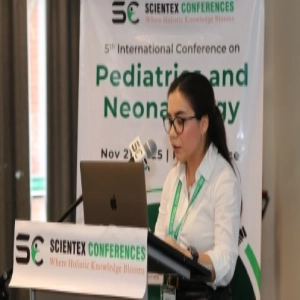





Larysa Kalashnikova
Igor Sikorsky Kyiv Polytechnic Institute, UkrainePresentation Title:
Psychosomatic mechanisms of regulation of external respiration function in children with bronchial asthma when listening to audio signals of various component composition
Abstract
Introduction. An integrated approach that includes both medicines and alternative methods that affect psycho-emotional state of the patient is used for bronchial asthma (BA) treatment. In this regard, one of the methods of the most powerful psycho-emotional impact on a person is musical influence. The research of the influence of audio signals (musical fragments) on human body in order to improve the psycho-emotional status of listeners began to be systematically undertaken since 2012 under the guidance of Professor Vitaliy Didkovskyi and Larysa Kalashnikova at the Department of Acoustics and Multimedia Electronic Systems of the National Technical University of Ukraine "Igor Sikorsky Kyiv Polytechnic Institute" jointly with the Department of Respiratory Diseases and Respiratory Allergies in Children of the Institute of Pediatrics, Obstetrics and Gynecology of the National Academy of Medical Sciences of Ukraine under the guidance of Serhiy Bartenev.
The objective of this work is to study effectiveness of influence of different amplitude-frequency range audio signals on the central mechanisms of ventilation capacity regulation of the bronchi of patients with asthma.
Material and methods. Twenty-five children aged from 9 to 14 years with clinically established BA participated in the research. Three melodies of different component composition were used. Their amplitude-frequency characteristics were analyzed by Matlab environment. The sound energy fraction of the studied musical compositions in one-third octave frequency bands throughout the duration of the audio signal was calculated. Statistical processing of the data was performed using the IBM SPSS Statistics software.
Results. The results of the study indicate that the most effective musical influence is provided by audio excerpt from The Magic Flute by W. A. Mozart. It has been established that the main spirographic indicators of the bronchopulmonary obstruction increase under the influence of music and, correspondingly, there are changes in the integral characteristics of the brain bioelectrical activity.
Conclusion. The study results demonstrate reliable normalization of spirography indicators in children with bronchial asthma under the influence of selected musical melodies of a specific frequency. The most effective normalization of respiratory function in children with bronchial asthma was achieved by listening to musical fragment 3 - a fragment featuring W.A. Mozart's "The Magic Flute." The fragment contains sound signals with a predominance of low and mid frequencies. Listening to fragment 3 promotes changes in the activity of the α- and β-rhythms and a reduction in psychoemotional stress.
The effectiveness of the sound influence on the central regulation mechanisms of the bronchi ventilation capacity can be used for preventive and therapeutic purposes.
Biography
Larysa Kalashnikova is an associate professor and deputy dean for international affairs at the faculty of Biomedical Engineering, National Technical University of Ukraine “Igor Sikorsky Kyiv Polytechnic Institute.” She holds a Ph.D. in Biology from Taras Shevchenko National University of Kyiv, earned in 1994. Her research focuses on the therapeutic use of sound and ultrasound signals in the rehabilitation of patients with bronchopulmonary disorders, including the application of low-frequency ultrasound for improving respiratory function and reducing medication needs. She has also explored the impact of acoustic stimulation on cognitive function and the potential of music therapy for asthma patients. Earlier in her career, she conducted studies on the toxicity and biological activity of newly synthesized compounds at the V.P. Kukhar Institute of Bioorganic chemistry and petrochemistry.